DLS Method in Cricket Explained: Par Score, IPL Examples & How It's Calculated
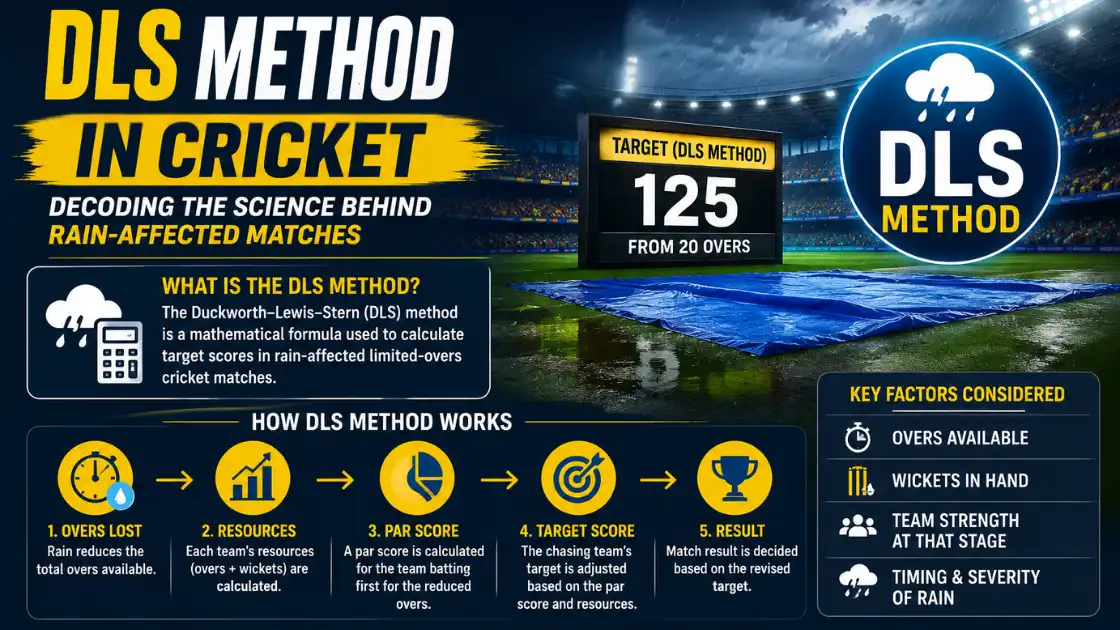
The DLS (Duckworth-Lewis-Stern) method is the official formula cricket uses to set a fair, revised target when a rain-affected match cannot be completed in full. It works out a “par score” for the team batting second, based on how many overs and wickets each side has left, instead of simply reducing the target run-rate.
If you’ve watched an IPL game get interrupted by rain and seen the target suddenly jump from, say, 180 to 165 in 15 overs, that number didn’t come out of nowhere — it came from the DLS method. This guide explains exactly what it is, how the calculation actually works, why it exists, and how to read a DLS par score the next time it shows up on your screen.
Quick Answer: What DLS Does
| Term | Meaning |
|---|---|
| DLS Method | Formula used to revise targets when rain interrupts a match. |
| Par Score | Score needed to stay level with the DLS calculation at any stage. |
| Resources | Overs remaining and wickets in hand used in the DLS formula. |
| Full Form | Duckworth-Lewis-Stern. |
| Used In | ODIs, T20Is, IPL, and most limited-overs tournaments. |
| Not Used In | Test cricket. |
What Is the DLS Method?
Rain has always been cricket’s biggest scheduling headache. Before a proper mathematical solution existed, revised targets were worked out using basic run-rate comparisons — a method widely criticized as unfair, since it ignored how many wickets a team had lost.
The Duckworth-Lewis (D/L) method was created by English statisticians Frank Duckworth and Tony Lewis specifically to fix this. Instead of just looking at the run rate, it treats overs remaining and wickets in hand together as a team’s combined “resources” for the rest of the innings. The ICC officially adopted it in 1999. In 2014, Australian statistician Steven Stern refined the model further, and it was renamed the Duckworth-Lewis-Stern (DLS) method — the version still used today.
In plain terms: a team with 10 overs left and all 10 wickets in hand has far more scoring potential than a team with 10 overs left and only 2 wickets in hand. The DLS method accounts for that difference — a simple run-rate cut never could.
How the DLS Par Score Is Calculated
The DLS formula converts overs and wickets into a single “resource percentage” using pre-calculated statistical tables built from decades of historical scoring data. Every possible combination of overs-remaining and wickets-lost maps to a resource percentage.
The basic logic works like this:
- Each team starts an innings with 100% resources (all overs, all wickets).
- As overs are bowled and wickets fall, that resource percentage drops.
- When a stoppage happens, the system calculates exactly how much resource percentage each side had available.
- The chasing team’s target is adjusted proportionally to the resources each team actually got to use.
Simplified formula for the revised target:
Team 2’s Target = Team 1’s Score × (Team 2’s Resource % ÷ Team 1’s Resource %)
Why not just reduce the target proportionally?
Imagine Team A scores 280 in a full 50 overs, but rain cuts Team B’s chase down to 40 overs. A simple proportional cut (280 × 40/50 = 224) sounds fair — but it isn’t. Team B still has all 10 wickets in hand for those 40 overs, which is a real batting advantage a straight run-rate cut ignores completely. DLS corrects for this by rewarding the side with more wickets in hand and penalizing the side that had used more of its resources when the stoppage occurred. That’s why a DLS target is very often higher than a simple proportional cut would suggest, not lower.
A Simplified Worked Example
- Team A bats first and scores 250/8 in 50 overs.
- Rain arrives before Team B’s innings starts, and their chase is reduced to 40 overs.
- A basic run-rate cut would set the target at around 200.
- But because Team B still has all 10 wickets available for those 40 overs (an advantage Team A didn’t have across their full 50), the DLS system calculates a revised target somewhat higher than the simple proportional number — often in the 210–215 range, depending on the exact resource tables used.
The exact number always comes from the official DLS software used by match officials — broadcasters and fans see only the final output, not the underlying resource tables, which is why the number can look confusing without this context.
Par Score vs Target Score: What's the Difference?
These two terms get used interchangeably by commentators, but they mean slightly different things:
- Target Score is a single, fixed number — the total runs the chasing team needs to win, set once the match length is finalized.
- Par Score is a moving number — it’s recalculated ball by ball throughout the second innings, showing what the chasing team’s score “should be” at that exact point (given the wickets they’ve lost) to be level under DLS.
If the match is abandoned mid-chase, whichever team is ahead of the live DLS par score at that moment is declared the winner. This is exactly why you’ll see a “DLS Par Score” ticker appear on your screen during any rain-threatened chase — it’s not the final target, it’s a live fairness check.
DLS Method in the IPL: How It's Applied
The IPL follows the standard ICC-endorsed DLS method for every rain- or wet-outfield-affected match, since it’s a T20 tournament. A few IPL-specific points to know:
- Minimum overs to constitute a result: In IPL T20 matches, the chasing team generally needs to face a minimum number of overs (typically 5) for a DLS result to be applied; if fewer overs are possible, the match is called a no result.
- Frequent mid-tournament use: Because the IPL runs through India’s pre-monsoon and monsoon-adjacent months across multiple cities, DLS comes into play several times most seasons — making it one of the most searched cricket terms during the tournament window.
- Revised targets can shift fast: In T20s, resource percentages change quickly over just a handful of overs, so IPL DLS targets can swing more dramatically than ODI ones for the same amount of lost playing time.
- Two-innings-affected matches: If both teams’ innings are shortened (say, the first innings itself was cut short by rain, and then the second is also reduced), DLS recalculates using both teams’ actual resources used, not just a single-sided adjustment.
DLS Method: Step-by-Step (How Officials Apply It Mid-Match)
- Play is stopped due to rain, bad light, or a similar interruption.
- Overs lost are recorded, and officials use certified DLS software (not a public calculator) to work out updated resource percentages for both teams.
- A revised target and/or par score is generated based on those resource percentages.
- Play resumes with the new target displayed, or if no more play is possible, the result is decided using the par score at the point of abandonment.
- The chasing team’s target updates automatically if there’s a further interruption later in the same innings.
Frequently Asked Questions
DLS stands for Duckworth-Lewis-Stern, the mathematical method used to set a fair, revised target in a limited-overs match that's interrupted by rain or another stoppage.
It's the same Duckworth-Lewis-Stern formula used across all professional limited-overs cricket, applied whenever an IPL match is shortened by rain or a wet outfield, to calculate a fair revised target based on overs and wickets remaining.
The par score is the score the chasing team should have reached, at their current number of wickets lost, to be exactly level under the DLS system at that point in the match. It updates continuously through the second innings.
It's based on a "resources" model combining overs remaining and wickets in hand for each team, converted into a resource percentage using pre-built statistical tables, then used to proportionally adjust the target.
Because DLS accounts for wickets in hand, not just overs. A team with more wickets remaining has more scoring potential, so the system often sets a higher target than a basic proportional run-rate reduction would.
Both. DLS is used in all major limited-overs formats — T20Is, the IPL and other domestic T20 leagues, and ODIs, wherever a match is affected by weather or another stoppage.
Statisticians Frank Duckworth and Tony Lewis created the original D/L method in the 1990s. Steven Stern later refined the model in 2014, after which it was renamed Duckworth-Lewis-Stern (DLS).
Yes. If a match is abandoned mid-chase, the team ahead of the live DLS par score at the moment of abandonment is declared the winner, provided the minimum overs requirement has been met.
Key Takeaway
The DLS method exists to solve one simple problem: rain shouldn’t be allowed to make a cricket result unfair. By treating overs and wickets together as “resources” rather than looking at run rate alone, it gives both teams a mathematically balanced target no matter how a match gets interrupted. Once you understand that the par score is really just a live fairness tracker — not the final target — the number on your screen stops being confusing and starts being useful.
Arjun Mehta writes about cricket news, player profiles, match analysis, tournament updates, records, and fantasy cricket tips at OnlineCricketID.online. He focuses on researching the game thoroughly and presenting reliable, easy-to-understand content for cricket fans. For more explainers like this one, keep exploring the cricket rules and match-analysis section on OnlineCricketID.
Read more

Powerplay in Cricket: Rules, Overs & Fielding Restrictions
Read this to know more about powerplay and what its uses in cricket match.
DLS Method Explained: What It Means & How It's Calculated
Read this to know DLS formula and how it works and support while raining.