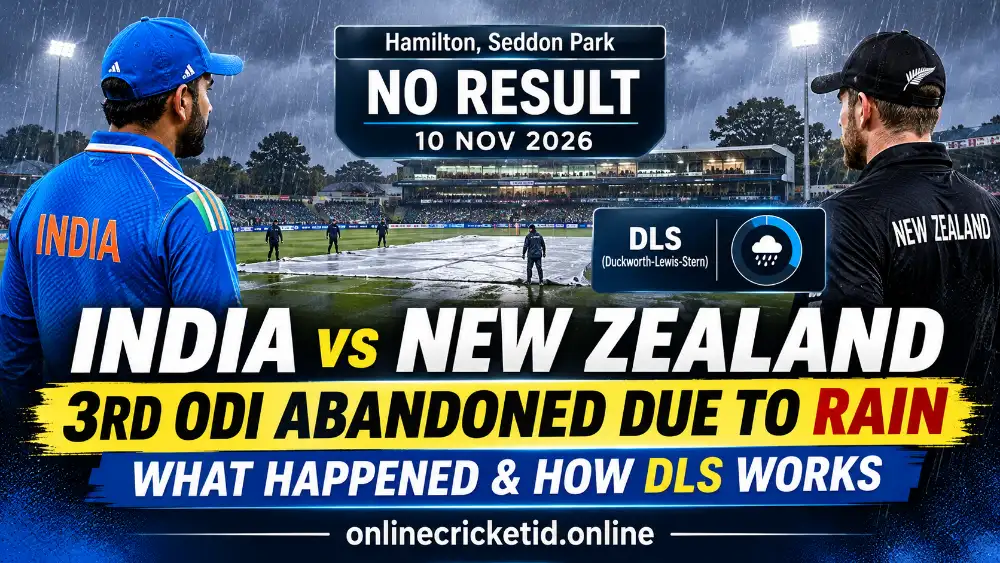
Quick answer: The third ODI between India and New Zealand at Seddon Park, Hamilton, was abandoned due to persistent rain on Tuesday, 10 November 2026, without a ball being bowled. India keep their 2-0 lead in the five-match series and can no longer lose it. New Zealand can still draw the series 2-2 only by winning the remaining two matches.
Rain has been a constant presence on New Zealand’s tour of this series. The Hamilton fixture was the first match of the series to be washed out completely, and it has left fans asking two questions: what exactly happened on the ground, and what does it mean for the rest of the series? This guide answers both, and also explains the DLS method that decided the two earlier matches.
India vs New Zealand 3rd ODI at a Glance
| Match | India vs New Zealand, 3rd ODI (five-match series) |
|---|---|
| Venue | Seddon Park, Hamilton |
| Date | Tuesday, 10 November 2026 |
| Toss | Shubman Gill won the toss and India chose to bowl |
| Result | Abandoned without a ball bowled (no result) |
| Series status | India lead 2-0 with two matches remaining |
What Happened in Hamilton
The day started with rain, and the start of play was delayed by around two hours because of intermittent showers and a wet outfield. Once the toss took place, India elected to bowl, which made it three matches in a row in which the Indian side chose to field first.
Persistent rain kept coming back, and the ground staff and match officials could not get the outfield into a condition fit for play. Officials attempted to prepare for a reduced-overs contest, but the weather did not cooperate. The match was called off without a single delivery bowled, so neither side earned a result from this fixture.
Because no overs were completed, the abandonment has no effect on the scoreboard in terms of runs or wickets. It does, however, have a major impact on the series picture, which is explained below.
How the Series Stands After the Washout
India’s series lead was built on the first two matches, both of which were shaped by rain and decided under DLS.
- 1st ODI, Eden Park: India won by five wickets while chasing a revised DLS target of 143.
- 2nd ODI, Hnry Stadium: India were 113 for 7 when rain stopped play, four runs ahead of the DLS par score, which gave them the victory and a 2-0 lead.
- 3rd ODI, Seddon Park: Abandoned without a ball bowled.
- 4th ODI, Bay Oval: India vs New Zealand, November 13, 2026.
- 5th ODI, Bay Oval: India vs New Zealand, November 15, 2026.
With two matches left, India need just one more win to seal the series. New Zealand must win both remaining matches to level the series at 2-2. Because the Hamilton match produced no result, India can no longer lose the series, which takes a lot of pressure off the visitors.
Captaincy Change for the Final Two ODIs
Shubman Gill and KL Rahul are set to leave the squad to prepare for the Test series, so vice-captain Shreyas Iyer is expected to lead India in the final two ODIs. Iyer will be the man to watch as India look to close out the series.
You can follow the player profiles for Shreyas Iyer, Shubman Gill and KL Rahul on our site, and check our latest cricket news for updates on squad changes.
Why Rain Has Shaped This Series
Every match in this series has been affected by the weather. The first two games were both finished under the DLS method, and the third was washed out entirely. Rain interruptions are a regular feature of cricket in New Zealand during the November season, and teams need to plan for them. This is one reason why DLS calculations come up so often in discussions of New Zealand matches.
How the DLS Method Works
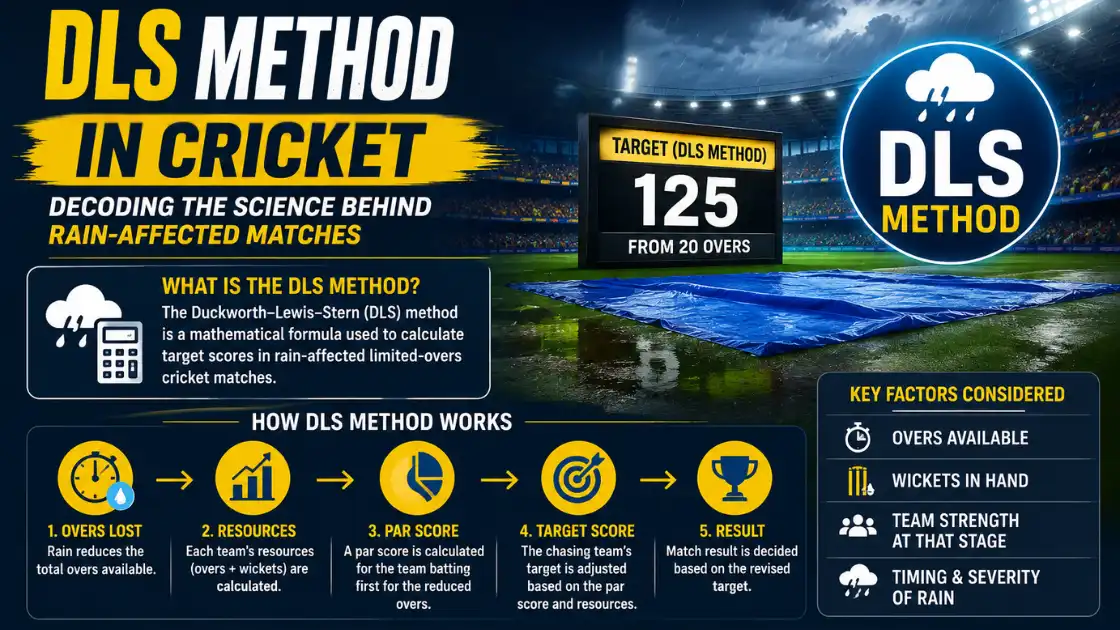
The DLS method, short for Duckworth-Lewis-Stern, is the system used by the ICC to set a fair target or decide a result when a limited-overs match is interrupted by rain or bad light. It was developed by statisticians Frank Duckworth and Tony Lewis, and Steven Stern was later added to the team, which is how the name is written today.
The Core Idea: Resources
DLS does not simply compare runs scored. It measures how many resources each side has. Resources are based on two things: the overs still available and the wickets still in hand. A team with ten wickets and all fifty overs has 100 percent of its resources. Once wickets fall or overs are lost, the percentage drops.
Key Terms You Need to Know
- Par score: The score the chasing team should have reached at the point where play stopped, based on the resources it had used up.
- Revised target: The score the chasing team needs to win, calculated after the first innings is cut short or the second innings is reduced.
- Resources remaining: The percentage of a team’s batting capacity still available, combining overs and wickets.
- Minimum overs: A DLS result needs a minimum number of overs to be bowled. In an ODI this is 20 overs per side before a result can be declared.
How a Result Is Decided
When play stops in the second innings, the chasing side is compared with the par score. If it is ahead of par, it wins, and the margin is recorded as the number of wickets still in hand. If it is behind par, the side batting first wins, and the margin is the number of runs the chasing side is short of par. This is why a DLS win is sometimes described as a wicket margin and sometimes as a run margin, depending on which side wins.
The Wellington match is a good example. India were 113 for 7 and four runs ahead of par when rain stopped play, which gave them the win and the series lead.
What This Means for Fans Now
The series is still very much alive for New Zealand, but India are in a strong position. With two ODIs remaining, every match now carries extra importance because the outcome will decide whether the series ends 3-0, 3-1 or 3-2 in India’s favour, or whether New Zealand can force a 2-2 finish. Shreyas Iyer’s captaincy and the performances of the bowlers will be closely watched.
For live updates on the remaining matches, visit our live score page. If you want to know more about the grounds that host these matches, our cricket grounds guide covers the venues in detail.
Frequently Asked Questions
The match at Seddon Park, Hamilton, was abandoned because of persistent rain and a wet outfield. The toss took place after a delay of about two hours, but no ball was bowled.
India lead the five-match series 2-0 and cannot lose it. New Zealand can only level the series at 2-2 by winning both remaining matches.
DLS, the Duckworth-Lewis-Stern method, is used to set a revised target or decide a result when rain interrupts a limited-overs match. It combines overs remaining and wickets in hand to calculate a par score.
Vice-captain Shreyas Iyer is set to lead India in the final two ODIs, as Shubman Gill and KL Rahul leave for Test series preparations.
Arjun Mehta (Admin) is a cricket writer at Online Cricket ID, covering international cricket, match updates, player performances, and tournament analysis. He focuses on researching match developments and explaining cricket rules, including the DLS method, in a clear and easy-to-understand way for readers.
Read more

Powerplay in Cricket: Rules, Overs & Fielding Restrictions
Read this to know more about powerplay and what its uses in cricket match.
DLS Method Explained: What It Means & How It's Calculated
Read this to know DLS formula and how it works and support while raining.